TL;DR — What's Happening Now
- Bitcoin trades around $71,282 — up from the $64K bottom earlier in April, but the Fear & Greed index still sits at 16/100 ("Extreme Fear")
- US spot Bitcoin ETFs took in $786 million this week (as of April 12) — the strongest weekly inflow since February, according to BeInCrypto
- BlackRock's IBIT alone accounted for $612 million of these inflows
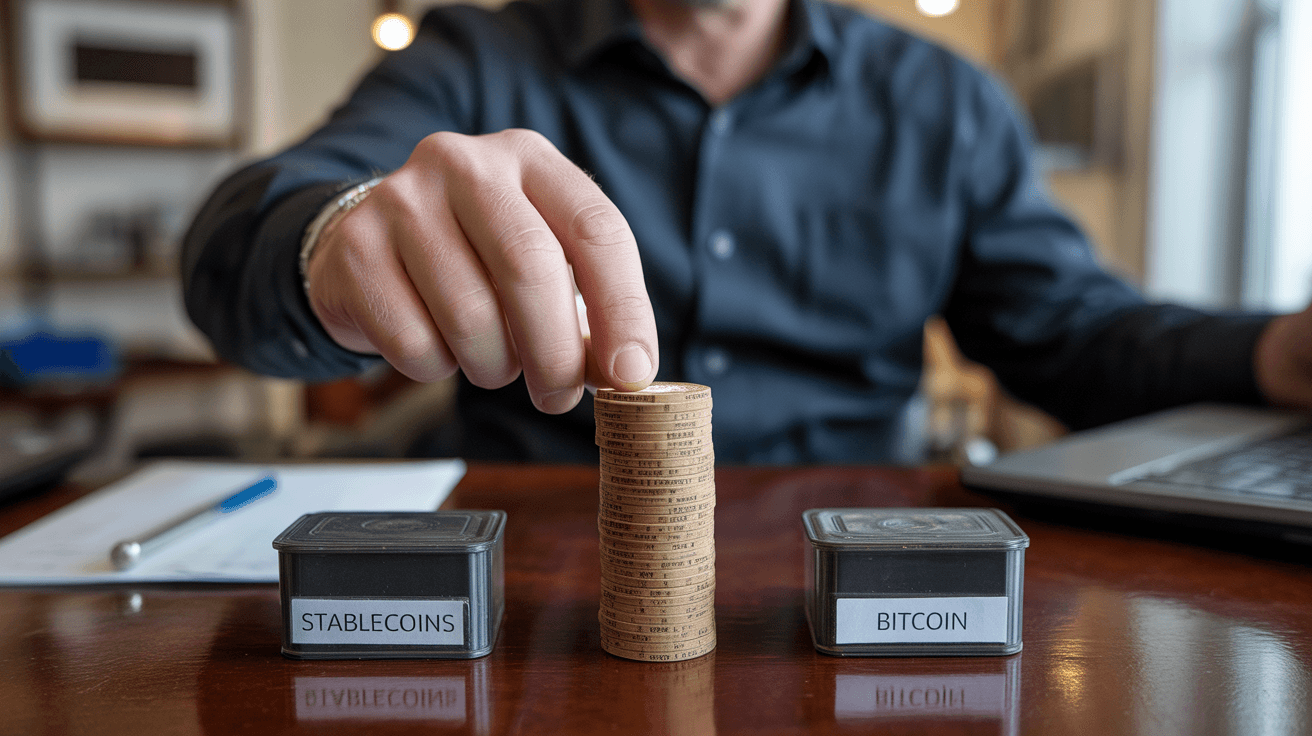
- On-chain data indicates that stablecoin capital is beginning to rotate out of "shelter" positions and back towards risky assets
- Short Bitcoin products received $16 million in inflows — the highest since November 2025 — indicating that the market is far from agreeing on the direction
What's Driving the Movement
The most important driver right now isn't price — it's capital rotation. Bitcoinist reports on on-chain signals indicating that stablecoin capital, which accumulated during the market's risk-off phase, is beginning to reverse. It's a pattern analysts have learned to respect: when investors stop hoarding USDT and USDC and start exchanging them for BTC, it's typically an early sign that risk appetite is returning.
Today, Tether's market cap alone is $184 billion — around 58% of the global stablecoin market. USDC follows with $73.6 billion. Together, these two represent over two-thirds of the stablecoin universe. These are enormous capital pools that could potentially be rolled into BTC and the rest of the market if the risk-on sentiment solidifies.
On the ETF side, the numbers are concrete: according to CoinShares, digital asset products globally took in $224 million in the week ending April 7, with Switzerland as a surprising geographical anchor for $157 million — almost 70% of the total volume. The US contributed a modest $27.5 million that same week, but April 7 alone saw US spot Bitcoin ETFs record $471 million in daily inflows — the strongest single day since February 25, according to CoinGlass data cited by BeInCrypto.
CryptoQuant analyst Darkfost has observed that long-term holders (LTHs) have accumulated around 308,000 BTC since the end of November — a clear signal that "smart money" is not distributing, but holding.
The macro picture is more complicated. The DXY has been under pressure, and the S&P 500 navigates volatile waters after repeated threats of escalation in trade conflict rhetoric from Washington. QCP analysts noted that market behavior suggests that investors are increasingly disregarding immediate geopolitical risk — which is, in isolation, bullish for risky assets, but also implies that a negative shock could hit hard.
"A growing stablecoin supply is not a bullish signal in itself — it's the subsequent drop in supply that tells you money is flowing back into the market."
Key Figures

Altcoin Overview
The week offered some clear winners and a clear loser in the altcoin segment:
XRP completely dominated institutional flows. CoinShares data shows that XRP products attracted $119–120 million during the week ending April 7 — more than half of the global total of $224 million, and the strongest weekly inflow since mid-December 2025. It's worth noting that XRP enthusiasm is driven by expectations related to regulatory clarity after the Ripple case, not necessarily by momentum in on-chain usage.
Solana (SOL) received modest but positive inflows of $34.9–35 million, indicating continued institutional interest, but far from a trend reversal.
Ethereum (ETH) is the week's clear loser on an institutional basis. Products linked to ETH saw outflows of $52.8–53 million last week, and year-to-date, a total of $327 million has now left ETH products. CoinShares' James Butterfill points to the CLARITY Act developments and stablecoin legislation as a central source of uncertainty surrounding Ethereum's positioning going forward. ETH is in a difficult squeeze between L2 cannibalization, weak fee revenue, and regulatory overhang.
Technical Picture
Bitcoin has managed to stay above the $70,000 level after breaking through it this week, but volume is not overwhelming, and the daily chart RSI is approaching overbought territory after the rapid recovery from the $64K bottom.
Key levels to watch:
- Support: $69,000–$69,500 (previous resistance now acting as support, high volume node in the volume profile)
- Support 2: $64,000–$65,000 (critical structure — bottom level from April correction)
- Resistance: $73,500–$74,000 (all-time high region from March 2024)
- Resistance 2: $76,000 (psychological level, strong selling pressure zone from December 2024)
Funding rates are not extreme, which is healthy in this phase — we are not seeing the euphoric overheating that often precedes steep short-squeezes followed by reversal. Open interest has climbed moderately but is not at alarming levels. The daily timeframe MACD is about to cross positively, but a confirmation close above $72,000 will be necessary to provide technical backbone to the bullish case.
Fear & Greed at 16/100 is historically a contrarian buy signal, but in a risk-off macro regime, the index can remain in "extreme fear" territory for an extended period. Do not use it as the sole argument for going long.
What to Watch For
Macro Calendar:
- FOMC Meeting (May): The Fed has signaled "higher for longer," but the market is pricing in cuts in H2 2026. A more hawkish tone would be directly negative for BTC.
- CPI Data (mid-April): Inflation surprises in either direction could lead to volatility. BTC has at times correlated closely with inflation surprises.
- Options Expiry: Large monthly BTC options expiries typically cluster at the end of the month — watch for pin-risk around round numbers.
Crypto-Specific Triggers:
- Will the stablecoin rotation from the Bitcoinist analysis continue and escalate? Another week of growth in ETF inflows towards $1 billion will significantly strengthen the bullish thesis.
- ETH vs. CLARITY Act: Congressional progress on stablecoin legislation could provide clarity that either lifts or stifles ETH sentiment.
- Short-seller activity: $16M into short Bitcoin products last week is a yellow flag. If this number grows, institutions are signaling increased hedging.
Levels to Monitor:
- $73,500: A break above here on high volume is the next technical bullish signal
- $69,000: Critical short-term support
- $64,000: Structural bottom — loss of this level fundamentally changes the picture
With Fear & Greed at 16 and ETF inflows at $786M in the same week — the market is sending conflicting signals. Price tells one thing; emotions tell something entirely different.