# Bitcoin ETF and Crypto Funds: How to Invest via Nordnet and DNB (2025 Guide)
What is an ETF and an ETP? The Basic Principle Explained
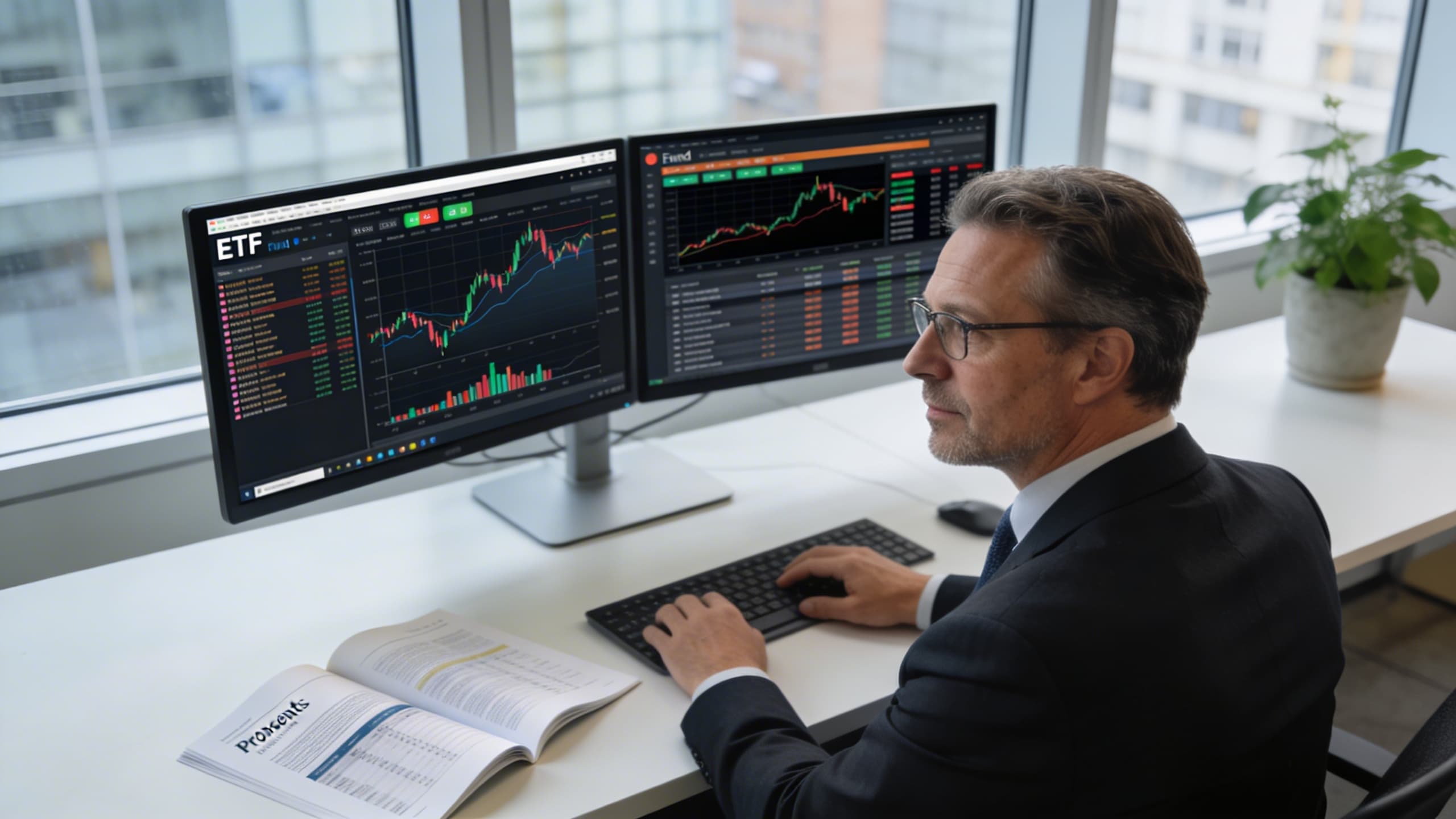
An ETF (Exchange-Traded Fund) is a fund traded on an exchange just like a stock. You buy and sell at market price during the trading day, and underlying assets — either stocks, gold, or Bitcoin — are reflected in the fund's value.
An ETP (Exchange-Traded Product) is the umbrella term covering all exchange-traded products, including ETFs. In the crypto context, it's important to distinguish:
- ETF (Exchange-Traded Fund): A fund structure with investor protection through the UCITS framework in Europe
- ETC (Exchange-Traded Commodity): A debt-based structure secured by physical crypto in custody — most common in Europe for crypto products
- ETN (Exchange-Traded Note): An unsecured debt instrument — higher counterparty risk
A Bitcoin ETP is not the same as owning Bitcoin — it is a financial instrument that tracks the price of Bitcoin.
The difference between spot and futures is crucial:
- Spot-ETF/ETP: The product is backed by actual Bitcoin in custody with an approved custodian. The price closely follows the spot rate.
- Futures-ETF: The product invests in Bitcoin futures contracts. This entails contango decay — a structural cost when futures contracts are rolled over — which can erode returns over time.
For most long-term investors, spot-based products are preferable.
Bitcoin Spot ETFs in the USA: BlackRock, Fidelity, and the Others
January 2024 marked a historic shift: the US SEC approved the first Bitcoin spot ETFs. This triggered a wave of institutional capital into the market.
The most important products:
| Produkt | Ticker | Forvalter | TER |
|---|---|---|---|
| iShares Bitcoin Trust | IBIT | BlackRock | 0,25 % |
| Fidelity Wise Origin Bitcoin Fund | FBTC | Fidelity | 0,25 % |
| ARK 21Shares Bitcoin ETF | ARKB | ARK Invest / 21Shares | 0,21 % |
| Bitwise Bitcoin ETF | BITB | Bitwise | 0,20 % |
| VanEck Bitcoin Trust | HODL | VanEck | 0,20 % |
Important for Norwegian investors: These are registered under US securities law and are generally not available for European private investors to buy directly via European brokers. The reason is that they do not meet the EU's PRIIPs requirements for having a Norwegian-language Key Information Document (KID). Professional investors can bypass this, but for ordinary private individuals, European alternatives apply.
Crypto ETPs Available in Europe
Europe has had crypto ETPs since 2019, but most are structured as ETCs (Exchange-Traded Commodities) since the UCITS framework prohibits funds with only one underlying asset. This means a somewhat different legal structure, but in practice, they function similarly for the investor.
21Shares
Swiss company, one of the largest crypto ETP issuers in Europe.
- 21Shares Bitcoin ETP (ABTC): Listed on Xetra (Frankfurt), SIX Swiss Exchange, and Nasdaq Stockholm. TER: 1.49%.
- 21Shares Ethereum ETP (AETH): TER: 1.49%.
- Custodian: Coinbase Custody and BitGo.
CoinShares
British-Swedish company listed on Nasdaq Stockholm.
- CoinShares Physical Bitcoin (BITC): Listed on Xetra and Euronext. TER: 0.35% — among the lowest in Europe.
- CoinShares Physical Ethereum (ETHE): TER: 0.35%.
- Custodian: Komainu (joint venture between Nomura, CoinShares, and Ledger).
ETC Group
German player with a broad product portfolio.
- ETC Group Physical Bitcoin (BTCE): Listed on Xetra. TER: 2.00%.
- ETC Group Physical Ethereum (ZETH): TER: 2.00%.
- Custodian: BitGo.
VanEck (Europe)
- VanEck Bitcoin ETP (VBTC): Listed on Xetra and Euronext Amsterdam. TER: 1.00%.
What Can You Buy via Nordnet?
Nordnet is the most crypto-friendly of the major Norwegian online brokers. Via Nordnet Norway, you can trade ETPs listed on:
- Nasdaq Stockholm — available via Nordnet's Swedish trading system
- Xetra (Frankfurt) — available via German market access
Specific products available via Nordnet (as of 2025):
| Produkt | Ticker | Børs | TER | Valuta |
|---|---|---|---|---|
| CoinShares Physical Bitcoin | BITC | Xetra / Euronext | 0,35 % | EUR |
| 21Shares Bitcoin ETP | ABTC | Nasdaq Stockholm | 1,49 % | SEK |
| 21Shares Ethereum ETP | AETH | Nasdaq Stockholm | 1,49 % | SEK |
| VanEck Bitcoin ETP | VBTC | Xetra | 1,00 % | EUR |
| ETC Group Physical Bitcoin | BTCE | Xetra | 2,00 % | EUR |
Search by ticker symbol in Nordnet's search bar. Choose the correct exchange if the product is listed in multiple places — Xetra typically has better liquidity than smaller exchanges.
Currency exchange: Purchases in EUR or SEK trigger automatic currency conversion from NOK. Nordnet charges a 0.25% currency surcharge. If you have a currency account in EUR or SEK, you can save this.
Important: Nordnet currently does not offer crypto ETPs via an equity savings account (ASK). They are traded on a regular Aktiekonto or Investeringskonto.
DNB's Crypto Products and Availability
DNB Markets and DNB Næringsmegling offer stock trading via the DNB Aksjehandel platform. Unfortunately, the crypto offering here is significantly more limited than at Nordnet.
As of 2025, DNB has not made it easy for private investors to buy European crypto ETPs directly via its platform. DNB Markets can facilitate trading in these products for professional and institutional clients, but for private individuals, availability is very limited.
DNB Livsforsikring, however, has shown interest in crypto as an asset class in some of its investment portfolios, but this is not directly available as a separate product for private investors.
Conclusion for DNB customers: If you want easy access to crypto ETPs, you should either open an account with Nordnet, Avanza (for Swedish customers), or consider other brokers.
Other Norwegian Brokers and Platforms
- SaxoBank: Offers broad access to European crypto ETPs on Xetra and other European exchanges. Spreads and fees are competitive for active traders.
- Pareto Securities: Primarily for professionals, but private investors with sufficient capital can gain access.
- Crypto exchanges (Firi, MiraiEx): Norwegian-registered platforms where you buy actual crypto — not ETFs. Important distinction.
Costs You Need to Know
The total cost of holding a crypto ETP is composite. Here are the most important components:
1. TER (Total Expense Ratio)
Annual management fee. Deducted continuously from the fund's value — you don't see it as a separate charge, but it eats into returns. Varies from 0.20% (USA) to 2.00% (some European) per year.
2. Spread
The difference between the buy and sell price in the market. For liquid products like BTCE on Xetra, the spread is typically 0.05–0.15%. For less liquid products, it can be higher.
3. Brokerage Fee (Kurtasje)
Nordnet's minimum brokerage fee for foreign stocks is *0.10%, minimum 29 NOK for Swedish stocks and minimum EUR 3* for European markets (prices may vary — always check Nordnet's current price list).
4. Currency Exchange
Nordnet's currency surcharge: 0.25% per transaction (buy and sell). Can be avoided by using a currency account.
5. Tracking error
The deviation between the ETF's actual return and the Bitcoin price movement. Caused by TER, rebalancing timing, and liquidity management. Normally small for spot ETFs, but it exists.
Tax Treatment in Norway
This is an area many underestimate — and it can have a significant impact on the net result.
Equity Savings Account (ASK) — not applicable
Crypto ETPs and crypto ETFs do not qualify for an equity savings account. ASK is reserved for stocks and equity funds (minimum 80% equity share). Since crypto ETPs are categorized as commodity products (ETCs), they fall outside the ASK regime.
Regular Account (Aktiekonto/Investeringskonto)
Profit from sales is taxed as capital income at 22% (2025 rate). Losses are deductible. There is no deferred taxation — you are taxed in the year you sell.
Investment Account (Unit Link)
Some insurance-based investment accounts with Norwegian providers may include ETPs and offer deferred taxation, but this is product-specific and should be checked with your provider.
Reporting
Purchases and sales of ETPs via Nordnet are automatically reported to the Norwegian Tax Administration (Skatteetaten). You will find profit/loss pre-filled in your tax return, but always check that the figures are correct.
The lack of ASK access is a real disadvantage for crypto ETPs — you lose the benefit of deferred taxation and flexible profit realization.
Advantages and Disadvantages Summarized
Advantages
- ✅ Regulated and familiar: Traded via established brokers with investor protection
- ✅ No wallet concerns: No risk of losing private keys
- ✅ Simple: Same interface as for stocks and funds
- ✅ Liquid: Can be bought and sold during the trading day
- ✅ Institutional custody: Crypto is stored with regulated entities like Coinbase Custody
- ✅ Tax simplification: Automatic reporting to the Tax Administration
Disadvantages
- ❌ You don't own crypto: No private keys — not your keys, not your coins
- ❌ No ASK access: Taxed continuously, not upon withdrawal
- ❌ Higher TER than US alternatives: European products typically cost 0.35–2.0% versus 0.20–0.25% in the USA
- ❌ Limited selection: Primarily Bitcoin and Ethereum — fewer altcoins
- ❌ Tracking error: Minor deviations from spot price can occur
- ❌ Currency risk: Products are priced in EUR or SEK
Step-by-Step: How to Buy a Bitcoin ETP via Nordnet
Here is a concrete walkthrough for a new investor:
Step 1: Open an account with Nordnet
Go to nordnet.no and register. You need BankID. Choose Aktiekonto (not ASK, as crypto ETPs are not qualified there).
Step 2: Transfer money
Transfer NOK from your Norwegian bank account to your Nordnet account via online banking. Allow 1–2 business days for processing the first transfer.
Step 3: Find the product
Search by ticker symbol in Nordnet's search bar:
- BITC for CoinShares Physical Bitcoin (lowest TER in Europe: 0.35%)
- ABTC for 21Shares Bitcoin ETP (available in SEK on Nasdaq Stockholm)
- Choose the correct exchange if the product is listed in multiple places.
Step 4: Analyze key information
Click on the product and read:
- TER (Total Expense Ratio)
- Custodian
- Key Information Document (KID) — mandatory for European products
Step 5: Place an order
- Choose Market order for simple execution, or Limit order to control the purchase price
- Enter the amount in units or NOK amount (Nordnet converts automatically)
- Confirm with BankID or Nordnet PIN
Step 6: Confirm trade
You will receive an order confirmation by email. The transaction will appear in your portfolio by the end of the trading day.
Step 7: Follow up
Nordnet displays your portfolio value in NOK at all times. Remember that value changes include both Bitcoin price development and EUR/NOK (or SEK/NOK) exchange rate.
Frequently Asked Questions
What is the difference between a Bitcoin ETF and a Bitcoin ETP?
An ETF (Exchange-Traded Fund) is a fund structure. In Europe, ETP is used as an umbrella term, and most crypto products here are technically ETCs (Exchange-Traded Commodities) — debt-based instruments secured by physical crypto. The difference is legal, but for the investor, they function practically the same.
Can I buy BlackRock's IBIT via Nordnet?
No. IBIT and other US Bitcoin spot ETFs are not available to European private investors via European brokers. They lack the required KID document under the EU's PRIIPs regulation. You must use European alternatives such as CoinShares BITC or 21Shares ABTC.
Are crypto ETPs safe?
They have investor protection through regulation, and the underlying Bitcoin is typically segregated from the issuer's assets with a regulated custodian. But they are not guaranteed by the Banks' Guarantee Fund, and the price can fall 80–90% in a bear market. The risk lies in the crypto price movement, not in the product structure per se.
Can I put crypto ETPs in an equity savings account (ASK)?
No. Crypto ETPs (ETCs) do not qualify for ASK. They are traded on a regular Aktiekonto and are taxed with 22% capital gains tax in the year you realize a profit.
Which crypto ETP is cheapest to hold in Europe?
CoinShares Physical Bitcoin (BITC) with a TER of 0.35% is among the cheapest European alternatives. In comparison, ETC Group Physical Bitcoin (BTCE) costs 2.00% per year — almost six times more.
What happens to my ETPs if the issuer goes bankrupt?
For physically-backed ETPs, the underlying crypto is segregated from the issuer's assets. In theory, it should be returned to investors. In practice, a bankruptcy can take time and involve legal complications. Read the prospectus carefully to understand the specific protection structure.
Should I use Nordnet or buy Bitcoin directly on a crypto exchange?
It depends on your purpose. Via Nordnet, you get easy administration, automatic tax reporting, and no wallet responsibility — but you don't own actual Bitcoin. On a crypto exchange like Firi, you own actual Bitcoin and can use it in DeFi, send it to others, etc. — but you are responsible for security and tax registration yourself.
Does Nordnet charge a currency fee when I buy ETPs in EUR?
Yes. Nordnet charges a 0.25% currency surcharge when converting from NOK to EUR (or SEK). This applies both ways — for buying and selling. If you have a EUR currency account with Nordnet, you can trade without this surcharge.
Are there crypto ETFs with exposure to multiple cryptocurrencies?
21Shares offers, among others, 21Shares Crypto Basket 10 ETP (HODL) which provides exposure to the 10 largest cryptocurrencies. CoinShares and VanEck also have various multi-asset ETPs. TER is often somewhat higher for such products than for pure Bitcoin products.
How are profits from crypto ETPs reported to the Tax Administration?
Nordnet automatically reports purchases, sales, profits, and losses to the Tax Administration. You will see this pre-filled in your tax return under stocks and securities. Profits are taxed as ordinary income (capital income) at 22%. Always check that the reported figures match your own records.