
# What Is Blockchain? The Technology Behind Crypto Explained (2025 Guide)
![Hero image: Server room with rows of computers]
What is blockchain — explained in one sentence?
Blockchain is a shared, immutable digital ledger where transactions are recorded in blocks that are cryptographically linked to each other, and which is maintained by a decentralized network of computers without any central authority.
That's the sentence you can memorize. But let's break it down into something that actually makes sense.
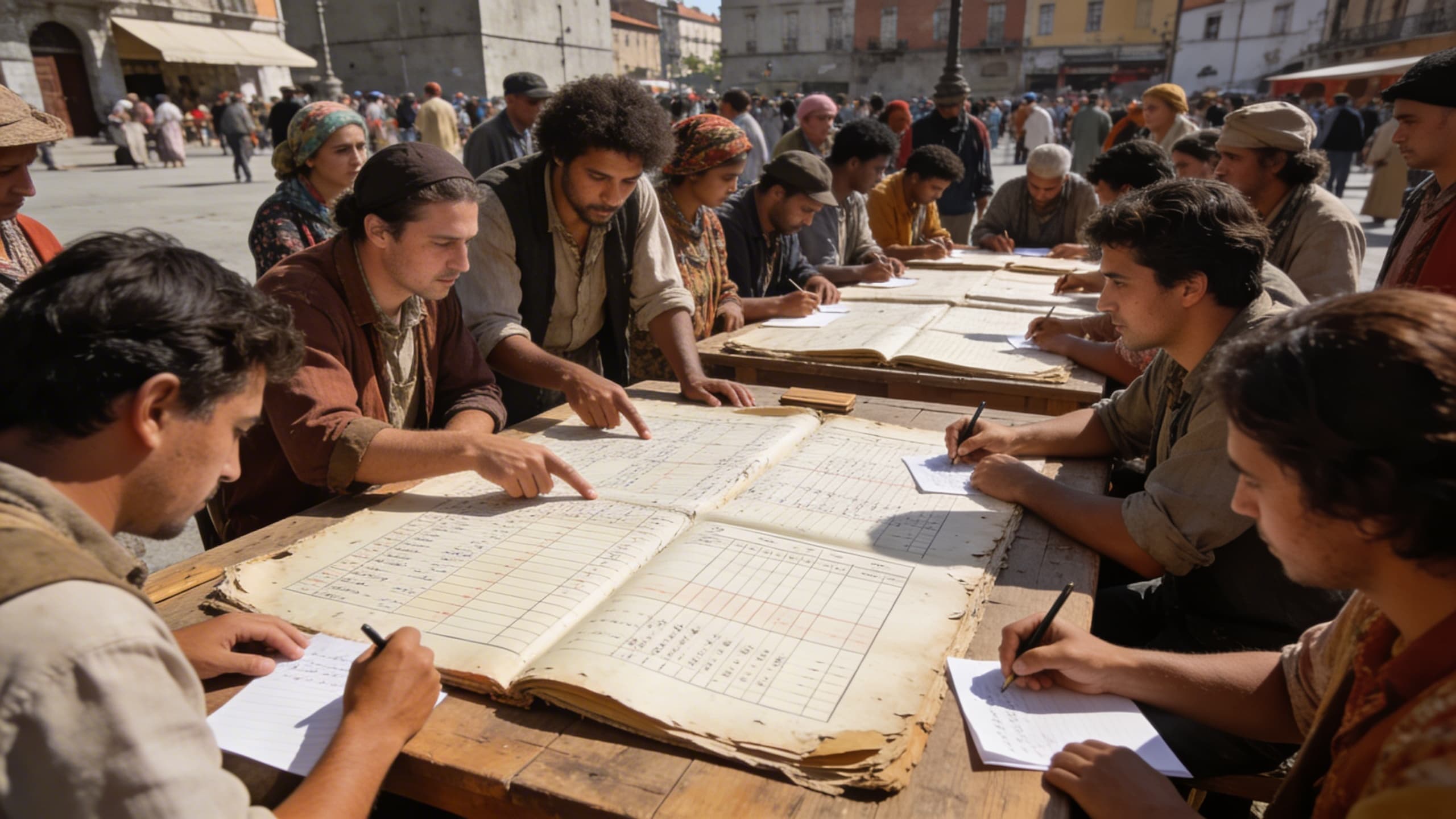
The Analogy: Imagine an accounting book no one can cheat with
Imagine you and 10,000 neighbors share a large accounting book. Every time someone sends money to someone else, it's written down in the book — and all 10,000 neighbors automatically get an updated copy.
Now Kari tries to erase her debt to Per. The problem? The other 9,999 neighbors all have a copy showing that the debt exists. Kari would have to convince more than half of all neighbors to change their copy simultaneously — a practically impossible project.
This is the essence of blockchain: transparency through sharing, and security through consensus.
Blockchain replaces the need for trust in a single institution with mathematically verifiable consensus among thousands.

How does a block work?
A blockchain consists of individual blocks, and each block contains three critical elements:
1. Transaction data
This is the actual content — for example: "Ola sent 0.5 BTC to Kari at 14:32:07 UTC on January 15, 2025." A single block on the Bitcoin chain can contain around 2,000–3,000 transactions.
2. A hash — the block's digital fingerprint
A hash is a long, unique string of text generated by a cryptographic algorithm (Bitcoin uses SHA-256). Input the text "Hello" and you will always get the same hash. Change a single letter to "hello", and the hash changes completely. There's no going back — you cannot reconstruct the original text from the hash.
Example of SHA-256 hash of "blockchain":
ef7797e13d3a75526946a3bcf00daec9fc9d1a309d33b8f7065a32c5b3a70e8
3. Previous block's hash
Here's where the magic happens: Each block contains the hash of the block that came before it. This creates an unbreakable chain. If you try to change data in block number 500, that block's hash changes — and then the hash in block 501 no longer matches, which in turn breaks block 502, and so on.
Consensus Mechanisms: Who decides what is true?
When thousands of computers hold copies of the same blockchain, they need a mechanism to agree on which transactions are valid. This is called a consensus mechanism.
Proof of Work (PoW) — Bitcoin
In Proof of Work, computers (called miners) compete to solve an extremely difficult mathematical puzzle. The first one to solve it gets to add the next block and receives a reward (currently 3.125 BTC per block after the 2024 halving).
The Analogy: Imagine you have to roll thousands of dice until you get all sixes. It's random and energy-intensive, but everyone can verify the result in one second.
- Advantage: Extremely proven and secure
- Disadvantage: Enormous energy consumption — the Bitcoin network uses approximately as much electricity as Poland
Proof of Stake (PoS) — Ethereum
In Proof of Stake, validators lock up cryptocurrency as collateral (stake). The more you stake, the greater your chance of being chosen to validate the next block. If you act dishonestly, you lose part of your stake (slashing).
Ethereum switched to PoS in September 2022 — the event known as "The Merge" — reducing energy consumption by an estimated 99.95%.
Decentralization: Nodes and distributed network
A node is simply a computer running blockchain software and holding a complete copy of the entire chain. The Bitcoin network has over 18,000 active nodes globally; Ethereum over 10,000.
This means:
- No single point of failure — even if 30% of the nodes shut down, the network lives on
- Censorship resistance — no government or company can shut down the network
- Transparency — anyone can download a full node and verify the entire history themselves
Compared to a bank, where all data is stored on the bank's own servers and you have to blindly trust that it is correct, blockchain provides mathematically verifiable transparency.
Smart contracts: Code that replaces intermediaries
Smart contracts are self-executing programs that reside on the blockchain. They run automatically when predefined conditions are met — without the need for a third party.
A simple example:
Ola and Kari bet 1 ETH on who wins a football match. They write a smart contract: "If Team A wins, transfer 2 ETH to Ola. If Team B wins, transfer to Kari." The contract reads the result from a reliable data source (oracle), and the money is paid out automatically. No arbitrator needed.
Ethereum is the dominant platform for smart contracts and is the basis for:
- DeFi (decentralized finance) — loans, trading, and yield farming without banks
- NFTs — unique digital proofs of ownership
- DAOs — decentralized autonomous organizations
![Middle image: Developers working at computers with lines of code on screen]
Public vs. private blockchains
Not all blockchains are created equal.
| | Public blockchain | Private blockchain |
|---|---|---|
| Examples | Bitcoin, Ethereum | Hyperledger Fabric, Corda |
| Who can participate? | Everyone | Invited participants only |
| Consensus | PoW / PoS | Approval-based |
| Decentralization | Full | Partial / centralized |
| Use case | Crypto, DeFi, NFT | Supply chain, banking collaboration |
Hyperledger Fabric, developed under the Linux Foundation, is used by companies like Maersk and IBM to track supply chains. Corda is built specifically for financial institutions. These are faster and more private, but sacrifice much of the decentralization that makes public blockchains revolutionary.
Layer 1 vs. Layer 2: Scalability problem solved?
The Ethereum network (Layer 1, or L1) can process around 15–30 transactions per second (TPS). In comparison, Visa handles up to 24,000 TPS. This is the blockchain trilemma: you can have decentralization, security, and scalability — but never all three at once without compromises.
Layer 2 solutions
Layer 2 protocols are built on top of Layer 1 that batch transactions and send a compressed proof back to the main network.
- Arbitrum and Optimism use "optimistic rollups" — they assume transactions are valid and allow a challenge period
- Base (built by Coinbase) is an Optimism-based L2 with strong growth in 2024–2025
- zkSync and Starknet use "zero-knowledge rollups" — mathematical proofs that verify validity immediately
The result? Arbitrum can process over 40,000 TPS with transaction fees under one Norwegian krone, while security is still anchored in Ethereum.
Layer 2 is the express lane running on the highway — you use Ethereum's security, but don't pay Ethereum's traffic jam price.
Blockchain beyond crypto
Blockchain technology's value doesn't stop at digital currencies.
Supply chain
Maersk and IBM built TradeLens — a blockchain to track over 800 million events in global shipping. Maersk discontinued the project in 2022 due to a lack of industry adoption, but the experience lives on in new initiatives. Walmart uses Hyperledger Fabric to track its food supply chain — from farm to store in seconds instead of days.
Digital identity
Self-sovereign identity (SSI) gives users control over their own digital identity credentials on the blockchain — without a centralized database that can be leaked. The EU project ESSIF (European Self-Sovereign Identity Framework) is an ongoing example.
Voting
States like Utah in the USA and countries like Sierra Leone have experimented with blockchain-based voting. Critics point out that the technology solves some problems (manipulation of vote counts) but creates new ones (digital access, anonymity).
Limitations you need to know
Blockchain is not a universal solution. The technology struggles with three real challenges:
In addition, smart contracts are only as good as the code they are written in. Errors in the code have cost DeFi protocols over 3 billion dollars in hacks and exploits since 2020 alone.
Blockchain technology in Norway
Norway is not a passive spectator in blockchain development.
Norges Bank (Norway's central bank) has explored central bank digital currency (CBDC) under the project name "DSP" (Digital Central Bank Money). In 2023–2024, they conducted technical tests and published open-source code for a proof-of-concept solution based on Ethereum technology.
DNB participated in the international Fnality project — a blockchain-based settlement platform for interbank transactions — alongside banks such as Barclays, UBS, and Santander.
SINTEF and NTNU have ongoing research on blockchain applications in energy trading, the marine industry, and digital trust. Norsk Hydro and Equinor have both experimented with blockchain for CO₂ tracking and supply chains.
Norwegian startups like Blockchange and Quantoz (now partly Dutch) have also made their mark internationally with stablecoin and compliance solutions.
![Closing image: Modern office building in Oslo with people meeting around a table with laptops]
Frequently Asked Questions
What is blockchain, simply explained?
Blockchain is a digital ledger that is copied and shared among thousands of computers. No single person controls it, and data recorded cannot be altered afterward without the network detecting it.
Is blockchain the same as Bitcoin?
No. Bitcoin is a cryptocurrency that uses blockchain technology. Blockchain is the underlying technology — just as the internet is the technology behind email. There are hundreds of different blockchains with different purposes.
Can blockchain be hacked?
The blockchain protocol itself is extremely difficult to attack directly — it would require control over more than 50% of the network's resources (a "51% attack"). Most hacks instead occur against exchanges, wallets, or smart contracts written with code errors, not against the chain itself.
What is the difference between Proof of Work and Proof of Stake?
Proof of Work requires computers to solve energy-intensive mathematical problems to validate transactions (Bitcoin). Proof of Stake requires validators to lock up cryptocurrency as collateral instead (Ethereum). PoS uses approximately 99.95% less energy than PoW.
What is a smart contract?
A smart contract is a computer program that runs automatically on the blockchain when predetermined conditions are met. It needs no intermediary and cannot be censored or stopped by a third party after it is published.
What is Layer 2 and why do we need it?
Layer 2 networks are built on top of an existing blockchain (Layer 1) to increase speed and reduce costs. Ethereum can process ~15–30 transactions per second; Layer 2 solutions like Arbitrum and Base can handle tens of thousands of transactions per second while still utilizing Ethereum's security.
Is blockchain anonymous?
Most public blockchains are pseudonymous, not anonymous. Wallet addresses are public and traceable, but not directly linked to an identity. With enough analysis (on-chain analytics), transactions can often be linked back to individuals, which companies like Chainalysis do professionally.
What is Norway doing with blockchain?
Norges Bank has tested central bank digital currency (CBDC) on Ethereum technology. DNB has participated in international blockchain settlement projects, and research environments at SINTEF and NTNU are working on blockchain applications in energy and the maritime sector.
What is the difference between a public and private blockchain?
A public blockchain (like Bitcoin and Ethereum) is open to everyone and fully decentralized. A private blockchain (like Hyperledger Fabric) is limited to approved participants, which provides more control and higher speed, but less transparency and decentralization.
How is blockchain relevant beyond crypto?
Blockchain is used to track supply chains (Walmart, Maersk), issue digital identity credentials, manage medical records, voting, and CO₂ tracking. The technology is in principle useful wherever you need a reliable, immutable log without a central trusted party.