
# Crypto Scams in Norway: How to Recognize the Scammers (2025 Guide)
![Hero-bilde: journalist ved skrivebord med to skjermer som viser transaksjonsdata og chatlogger, realistisk kontormiljø, dagslys fra vindu]
The Scope: How Much Money is Lost to Crypto Scams?
The FBI reported in its 2023 Internet Crime Report that Americans alone lost 5.6 billion dollars to crypto-related fraud — a 45 percent increase from the previous year. In Norway, official figures are harder to track, partly because many victims do not report due to shame or because they don't know who to contact. Nevertheless, the Financial Supervisory Authority of Norway (Finanstilsynet) and Økokrim (National Authority for Investigation and Prosecution of Economic and Environmental Crime) estimate that Norwegians lose several hundred million kroner annually to unregistered platforms and direct scams.
The Norwegian financial crime unit registered over 2,400 reports related to online investment fraud in 2023. A significant portion of these involved cryptocurrency as a means of payment or an investment object.
It is important to emphasize: being tricked by crypto scammers is not a sign of foolishness. These criminal networks — many of them operated from organized crime hubs in Southeast Asia and Eastern Europe — are sophisticated, patient, and brutally effective.
Pig Butchering: The Romance Scam That Ruins Lives
How Does It Work, Step by Step?
“Pig butchering” (in Chinese: 杀猪盘, shā zhū pán) is a metaphor for the process where scammers “fatten up” the victim over time — like a pig — before “slaughtering” them. This is how it typically unfolds:
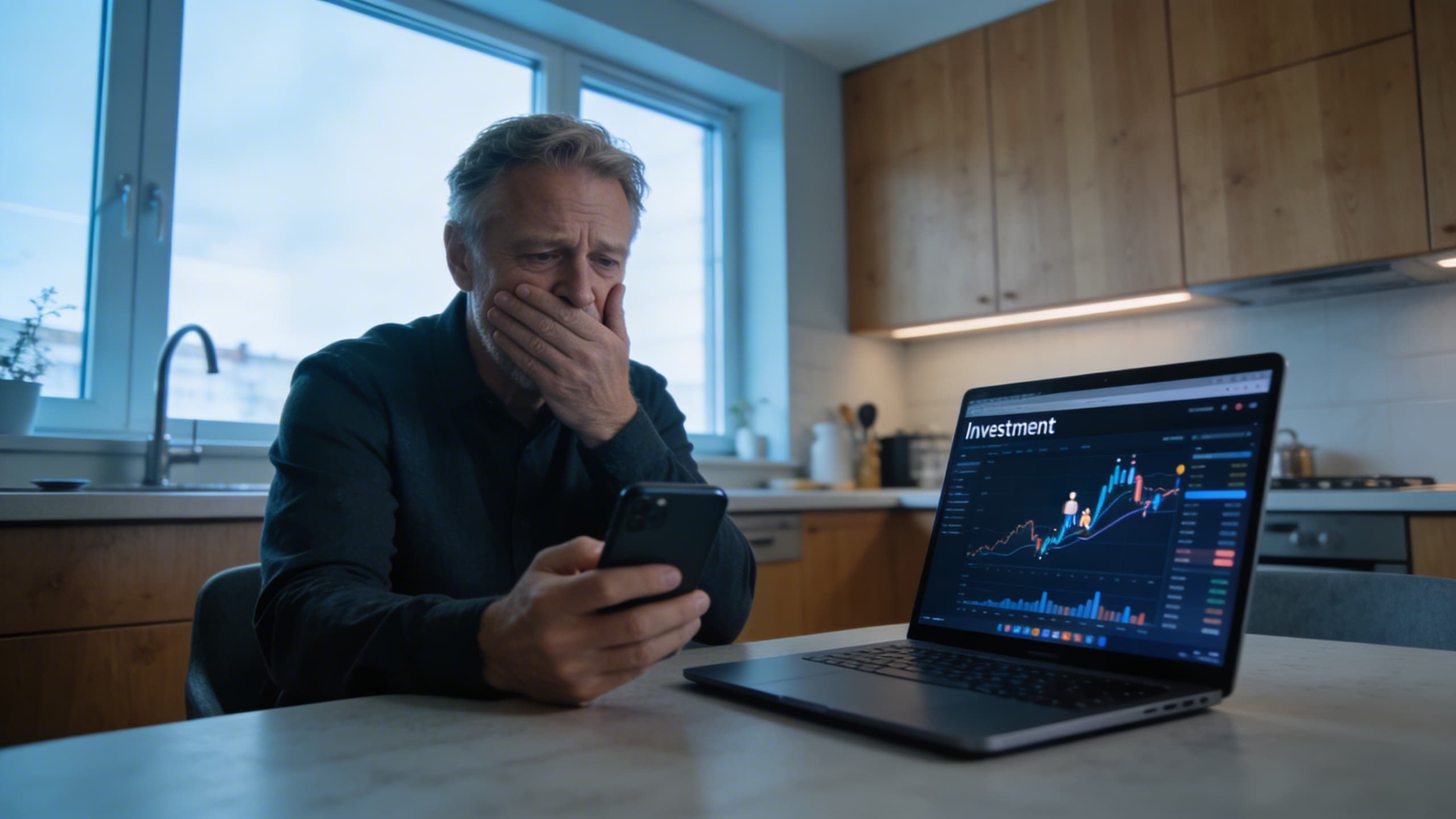
“I had been talking to her for three months. I thought we were lovers. I didn't even know it wasn't a real person.” — Norwegian victim, 54 years old
Phishing: Fake Websites and Google Ads Scams
Phishing in the crypto world is more technically sophisticated than you might think. Scammers buy Google Ads for keywords like “MetaMask,” “Ledger,” “Coinbase Norway” — and the ads appear above the organic results. If you click on such an ad, you land on a pixel-perfect copy of the real site.
Fake MetaMask pop-up windows can be injected via compromised browser extensions. You think you are approving a regular transaction, but in reality, you are signing a token approval that gives the attacker access to your entire wallet.
How to protect yourself against phishing:
- Bookmark all crypto sites you use — never click on links from searches or emails
- Always verify the URL carefully:
metamask.iovs.metamask-io.comvs.rnetamask.io - Use a hardware wallet (Ledger, Trezor) — these show transaction details on the device itself
- Never enter your seed phrase online, no matter how legitimate the site looks
Rug Pulls: Projects That Disappear Overnight
A rug pull occurs when the developers behind a DeFi project or token pull out all liquidity and disappear. In 2021–2022, we saw hundreds of such projects — Squid Game Token is the most famous example, where the price surged 75,000% before collapsing to zero in seconds.
Warning signs of a potential rug pull:
- Anonymous team without verifiable identity
- Smart contract not audited by a reputable company like CertiK or Hacken
- Liquidity is not locked — developers can withdraw it at any time
- Whitepaper is vague, full of buzzwords, and lacks technical substance
- Tokenomics give developers a disproportionately large share (over 20–30 %)
Pump and Dump: Telegram Groups and Influencer Scams
Pump and dump is illegal market manipulation that has existed in the stock world for generations but has found new life in crypto. This is how it typically works:
Influencer scams are a variant where well-known profiles (sometimes with hacked accounts, sometimes paid) promote tokens without disclosing compensation. In 2023, several American influencers were fined by the SEC for precisely this.
Fake Exchanges and Unregistered Platforms
![Midpoint-bilde: nærfoto av hendene til en person som skriver på laptop, skjerm viser en finansplattform med tall og grafer, nøktern kontorsetting]
The Financial Supervisory Authority of Norway (Finanstilsynet) maintains a register of enterprises authorized to offer financial services in Norway. A platform that is not registered there — and yet offers cryptocurrency trading to Norwegian users — operates illegally.
Fake exchanges are designed to look professional. They have convincing dashboards, customer service chat, and show you “gains” in real-time. But withdrawals are always blocked under some pretext.
Always check:
- Finanstilsynet's enterprise register
- Finanstilsynet's warning list of specific entities
- Registered address and legal company structure — verify it independently
Social Media Scams: Fake Elon Musk Giveaways and Deepfakes
There's a simple rule: no legitimate giveaway asks you to send crypto to get crypto back. Yet, thousands fall for this every year.
Scammers hijack or clone accounts with blue checkmarks on X (Twitter), YouTube, and Instagram. They run livestreams with deepfake videos of Elon Musk, Vitalik Buterin, or Norwegian celebrities, promising to double all deposits.
A deepfake scam featuring Elon Musk as the frontman was estimated in 2024 to have stolen over 25 million dollars globally within one week.
Wallet Drainers: Malicious Smart Contracts and Approval Traps
Wallet drainers are perhaps the most technically subtle form of crypto scam. You connect your wallet to a website (perhaps an NFT mint, a DeFi project, or a fake airdrop site), and approve a transaction without reading the details.
That transaction can contain a setApprovalForAll command that gives the attacker permission to move all tokens in your wallet — not just a single one. The attack often happens within seconds.
How to protect yourself:
- Use revoke.cash regularly to check and revoke unnecessary approvals
- Always read what you are actually signing — don't just blindly press “confirm”
- Use a separate “hot wallet” with a minimal balance for DeFi experimentation
- Hardware wallet for long-term storage
SIM-Swapping: When Hackers Take Over Your Phone Number
SIM-swapping is an attack method where a criminal convinces your telecom operator (Telenor, Telia, Ice) to transfer your mobile number to a SIM card they control. This is done via social engineering — they impersonate you, using personal data obtained from data breaches or social media.
Once they have your number, they can:
- Receive all SMS-based one-time codes (2FA)
- Reset passwords on exchanges and email accounts
- Empty associated crypto exchanges
Protection: Switch from SMS-based 2FA to an authenticator app (Google Authenticator, Authy) or a hardware security key (YubiKey). Contact your operator and ask to activate a SIM-lock or PIN code on your account.
Investment Scams: "Guaranteed 10% per Month", Cloud Mining, and MLM
A guaranteed monthly return of 10% equates to 214% per year. No legitimate investment delivers this.
Investment scams come in many forms:
- Guaranteed returns — “We have an AI bot that always makes money.” In reality, it's a Ponzi scheme where early investors are paid with new deposits.
- Cloud mining — You “rent” mining capacity that doesn't exist. Fees are deducted, and returns are absent or minimal.
- MLM models — You earn most by recruiting new participants, not from actual investment gains. Resembles classic pyramid schemes.
Warning Signs Checklist: 10 Red Flags You Should Always Look For
What Do You Do If You've Been Scammed?
![Closing-bilde: person i rolig møterom som snakker med rådgiver over bordet, dokumenter og laptop foran dem, naturlig lys, nøktern og profesjonell stemning]
First: don't be ashamed. These scammers are professionals. They use techniques developed by psychologists and data specialists. You are not alone.
Step-by-Step After a Scam Attack:
Finanstilsynet's Resources
Finanstilsynet regularly publishes warnings against specific entities on its website. They collaborate with European supervisory authorities through ESMA and EBA. The Authority also has a dedicated scam hotline and email address for tips.
If a platform actively markets itself to Norwegian users without permission, Finanstilsynet can instruct Norwegian banks to block payments to these entities.
Frequently Asked Questions
What is pig butchering scam?
Pig butchering is a romance-based investment scam where the scammer builds trust over weeks or months before luring the victim to invest large sums on a fake platform. The money is actually gone from the first krone — the dashboard showing “gains” is an illusion.
Can I get my money back after being scammed?
Crypto transactions are generally irreversible, but the blockchain trail can be used to identify and, in some cases, freeze funds at regulated exchanges. The chances increase significantly if you act quickly and contact the police immediately with all documentation.
What is a wallet drainer?
A wallet drainer is a malicious smart contract that — when you approve a seemingly innocent transaction — gives the attacker permission to move all tokens in your wallet. It typically occurs via fake NFT minting sites, airdrop websites, or compromised DeFi projects.
How do I check if a crypto platform is legal in Norway?
Go to Finanstilsynet's enterprise register at finanstilsynet.no and search for the platform's name and organization number. Also check Finanstilsynet's warning list. European sister organizations like the British FCA and German BaFin also publish their own useful warning lists.
Is it safe to use SMS-based two-factor authentication (2FA) on crypto exchanges?
SMS-based 2FA is significantly better than no 2FA, but vulnerable to SIM-swapping attacks. It is recommended to use an authenticator app (like Google Authenticator or Authy) or a hardware security key (YubiKey) for high-value accounts.
What is a rug pull?
A rug pull occurs when the creators of a crypto token or DeFi project suddenly pull all liquidity out of the project and disappear, rendering the token worthless. It most often happens with new, unknown projects where the team is anonymous and smart contracts are not audited.
What do I do if someone asks for my seed phrase?
Never, under any circumstances, share your seed phrase (the 12 or 24 words) with anyone — no matter who they claim to be. No legitimate entity, customer service, or technical support person will ever ask for this. It is the sole key to your wallet.
How do I report crypto fraud in Norway?
Report to the police via politiet.no or at your nearest police station. Send tips to Finanstilsynet via finanstilsynet.no/tips. If you have been scammed via social media, you can also report to the relevant platform. Consider contacting the Consumer Council for guidance.
Is cloud mining ever legitimate?
A few cloud mining companies operate legitimately, but the industry is infested with scams. Profitability is almost always better if you buy the crypto directly. Be extremely skeptical of any cloud mining service that promises guaranteed returns or uses MLM structures for recruitment.
Can deepfake videos really trick people?
Yes. Modern deepfake technology is good enough to trick most people in a short video featuring a known personality. Scammers use deepfakes of Elon Musk, Norwegian celebrities, and financial profiles to legitimize fake giveaways and investment platforms. If you are unsure whether a video is real — search for the original source directly.